Strikes
This is a very simple
embellishment. It merely consists
of striking your note finger on and off the chanter very quickly.
There are two exceptions - ‘B’ and ‘C’.
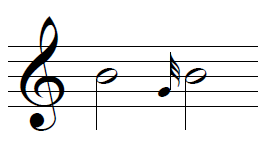
In both of these cases you divide the note into two by sounding a very
short low G, written as a Low
‘G’ gracenote. Be careful to remember to strike down only
one finger otherwise. Sometimes, and in some styles, people also play a low G gracenote between two Ds to repeat it. If
you see this in music then you can either replace it with a single
finger strike (written as a C gracenote) or be careful to make sure
only a G gracenote sounds and there are no crossing sounds.
It exists as a way of repeating a note.
HINT
From ‘B’, a common mistake
is sounding an extra Low ‘A’ in the strike. To avoid this, put down your little finger first, and lift it last. See
example 5.
Example - STRIKE ON ‘B’.
|
XX
|
XX
|
XX
|
XX
|
XX
|
|
X
|
X
|
X
|
X
|
X
|
|
X
|
X
|
X
|
X
|
X
|
|
|
|
|
|
|
|
X
|
X
|
X
|
X
|
X
|
|
X
|
X
|
X
|
X
|
X
|
|
O
|
O
|
X
|
O
|
O
|
|
O
|
X
|
X
|
X
|
O
|
|
|
|
|
|
|
|
B
|
Little
finger down
|
Sound
(and feel) Low G
|
Start
returning to B
|
Complete
B
|
Example
Strikes Exercises
ease complete the following exercises. Please make use of the five steps practise method - this is slow to begin with but will massively speed up your progress later. Do these at any speed which is comfortable.
Strikes exercise 1

Strikes exercise 2

Strikes exercise 3

Strikes exercise 4

Strikes exercise 5

Once you have completed all of these exercises you should return to the gracenotes and strikes
page and learn the mixed exercises to play along with the videos. This
will give you confidence that you are ready for the next section - other embellishments.