Teach Yourself Bagpipes by Lindsay Davidson
bringing quality 'piping instruction to you for free| Select course Site entry page | How to practise | Highland Bagpipe library (+videos and hints) | Lindsay Davidson's tune library (scores only) | Smallpipe library | Medieval pipes library | Site map |
| Buy Lindsay's Books | ||||||
Lady MacKenzie of Fairburn
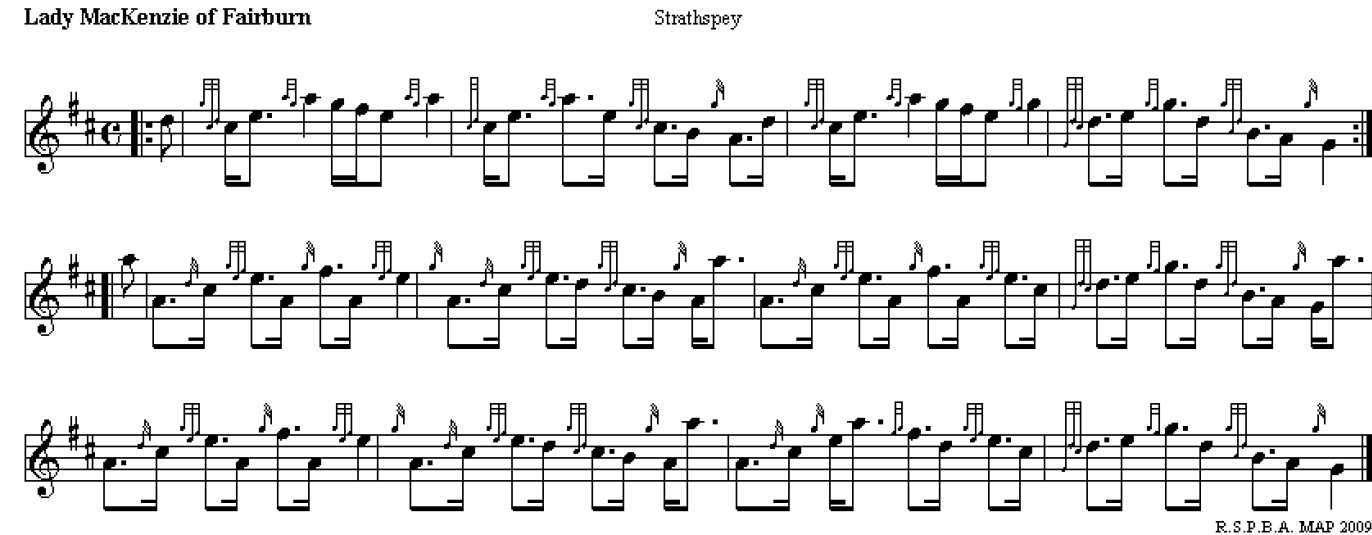
Five discussion points
1
C doubling bar 1 - some people call this rhythmical pattern a
'double tachum'. This is because we can think of it as a single action,
or also because the doubling fits into the space given to the C in a
tachum. To make this work and have the desired effect, and fit in the
given space, the D gacenote needs to be fantastically short (128th
note). Listen to the midi file..
2 High A doubling bar 1 - this is rhythmically identical to the C doubling. Knowing this should help get the feel for the rhythmical pattern into everyone's hands and heads.
3 High G gracenote from E to C bar 3 - this takes up a third of the last semiquaver of the beat, giving extra emphasis to the third beat in the bar.
4 Throw bar 4 - a kind of medium weighted throw - long low G and a short D and even shorter strike. Rhytmically this is identical to the C doublings (after the beat). Listen carefully to the midi file (and in time there will be an exercise about this, please keep coming back).
5 Bar 5 the first high G gracenote is shorter than all the others. This is a merely pragmatic step as to introduce triplets into this complex pattern is impractical for less experienced bands. Soloists might have a different approach.
Low pitch normal speed
Low pitch half speed
Low pitch quarter speed
High pitch normal speed
High pitch half speed
High pitch quarter speed
Low pitch half speed
Low pitch quarter speed
High pitch normal speed
High pitch half speed
High pitch quarter speed
Five exercises - follow the links for videos to play along with and more details
Exercise 1

Exercise 2

Exercise 3
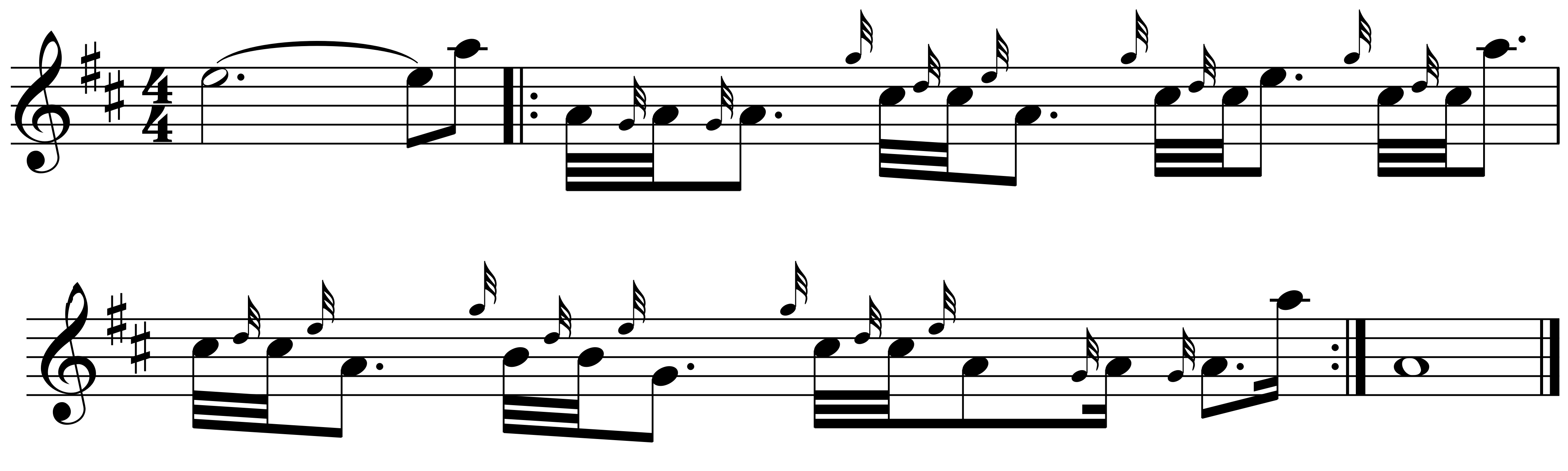
Exercise 4

Exercise 5

howtodothings.com
Site map and contents
Youtube Channel
Clan Davidson Virtual Pipe Band
GHB Exercises
SSP Library
SSP Exercises
Medieval Music Library