Teach Yourself Bagpipes by Lindsay Davidson
bringing quality 'piping instruction to you for free| Select course Site entry page | How to practise | Highland Bagpipe library (+videos and hints) | Lindsay Davidson's tune library (scores only) | Smallpipe library | Medieval pipes library | Site map |
| Buy Lindsay's Books | ||||||
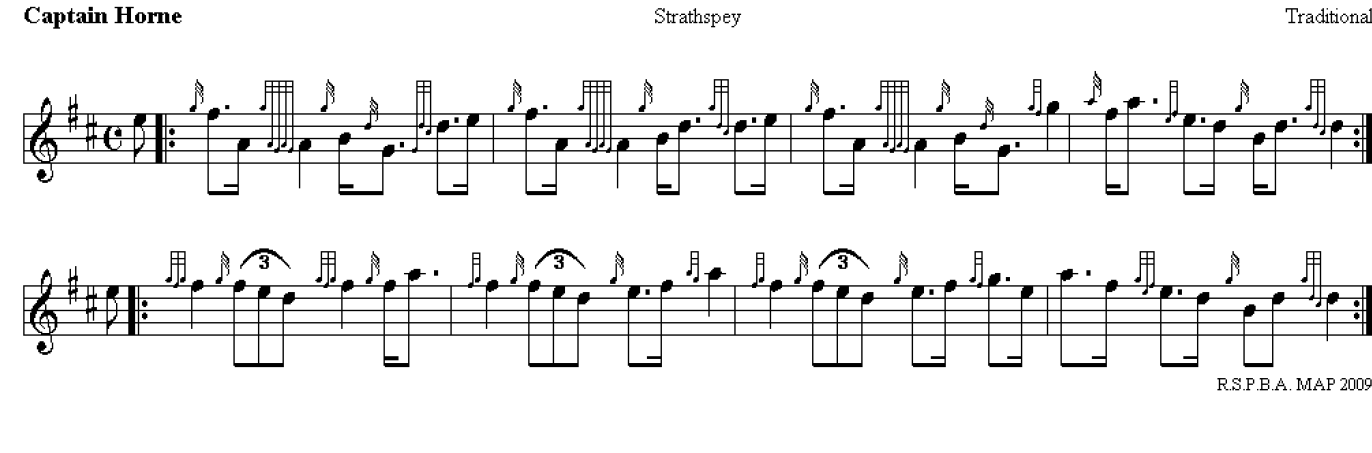
Captain Horne
Five discussion points
1 First high G gracenote bar 1 - this takes up a quarter of the 16th note preceding it (low A). To maintain the heavy weak medium weak beat pattern in strathspeys it is essential to soften the gracing which leads on to the second beat of the bar.
2 Tachum bar 1 - the high G gracenote fits into one third of the preceding 16th note, giving the effect of being a big gracenote. This helps create rhythmical balance and shape in the tune.
3 Throw bar 1 - the D and the C strike are the same length as each other. This is a common trick in strathspey playing as it makes the throw seem heavier without altering the low G (which as in this case isn't really avaialble for alteration).
4 Hara bar 2 - the strike comes up on the beat. Alternatives are possible but this choice has been made for this interpretation, and for playing together. Also, drummers have a variety of options which will match onto this well.
5 High G doubling bar 3 - as with the throw in bar 1, the G and F are the same length as each other to give a little extra emphasis. Listen carefully to the midi files.
Videos to play along with - exercises below
| Low Pitch normal speed |
| Low Pitch half speed |
| Low Pitch quarter speed |
| High pitch normal speed |
| High pitch half speed |
| High pitch quarter speed |
Five exercises - click on the link to go to a page for each exercise with comments and videos to play along with
Exercise 1

Exercise 2

Exercise 3

Exercise 4

Exercise 5

howtodothings.com
Site map and contents
Youtube Channel
Clan Davidson Virtual Pipe Band
GHB Exercises
SSP Library
SSP Exercises
Medieval Music Library