Teach Yourself Bagpipes by Lindsay Davidson
bringing quality 'piping instruction to you for free| Select course Site entry page | How to practise | Highland Bagpipe library (+videos and hints) | Lindsay Davidson's tune library (scores only) | Smallpipe library | Medieval pipes library | Site map |
| Buy Lindsay's Books | ||||||
O'er The Bows To Ballindalloch
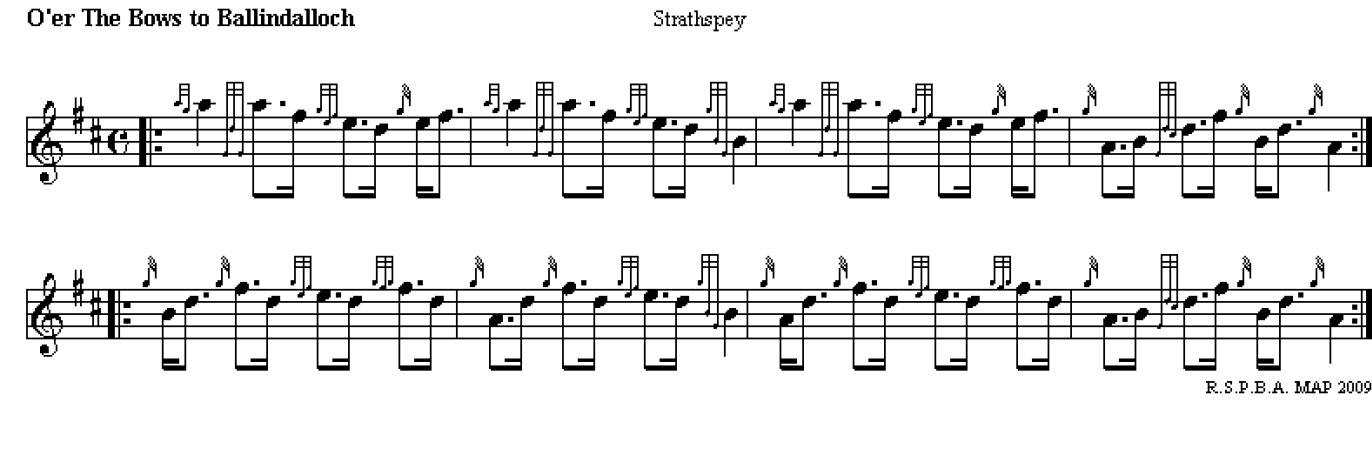
Five discussion points
1
Grip bar 1 and elsewhere - this is a short
grip, fitting
into a semiquaver. Make sure that both low Gs create the impression of
the being the same length (although they are not) and that the D
gracenote truly 'cuts' them.
2 Bar 1 E doubling - this is opened with a long high G gracenote, as it is on the third beat in the bar.
3 Bar 2/6 strike on B - this movement is treated like a doubling, a very heavy doubling, with the strike coming after the beat. Listen carefully.
4 Throw in bar 4, an interpretation not much used in these tunes.... The low G (before the beat) is a third of the preceding B, the D opens on the beat and the strike is a 32nd note. If you listen carefully to the videos, it isn't as bad as the description.
5 Bar 5 - you may hear this first note as a low A in some versions, indeed this is how the writer plays it (low A dotted quaver). Be aware there are other versions...
Videos to play along with - exercises below
Low pitch normal speed
Low pitch half speed
Low pitch quarter speed
High pitch normal speed
High pitch half speed
High pitch quarter speed
Low pitch half speed
Low pitch quarter speed
High pitch normal speed
High pitch half speed
High pitch quarter speed
Five exercises - to get videos to play along with click on the links
Exercise 1

Exercise 2

Exercise 3

Exercise 4
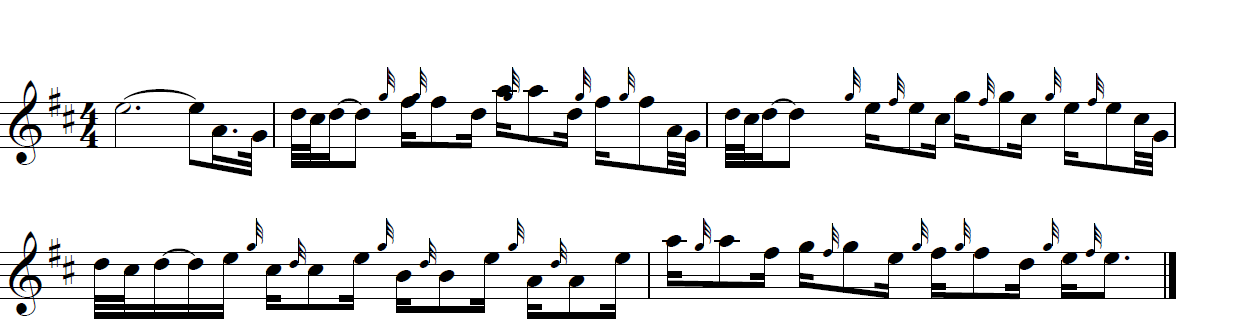
Exercise 5

howtodothings.com
Site map and contents
Youtube Channel
Clan Davidson Virtual Pipe Band
GHB Exercises
SSP Library
SSP Exercises
Medieval Music Library