Teach Yourself Bagpipes by Lindsay Davidson
bringing quality 'piping instruction to you for free| Select course Site entry page |
How to practise | Highland Bagpipe library (+videos and hints) |
Lindsay Davidson's tune library (scores only) |
Smallpipe library | Medieval pipes library | Site map |
| Buy Lindsay's Books | ||||||
The
Silver Spear

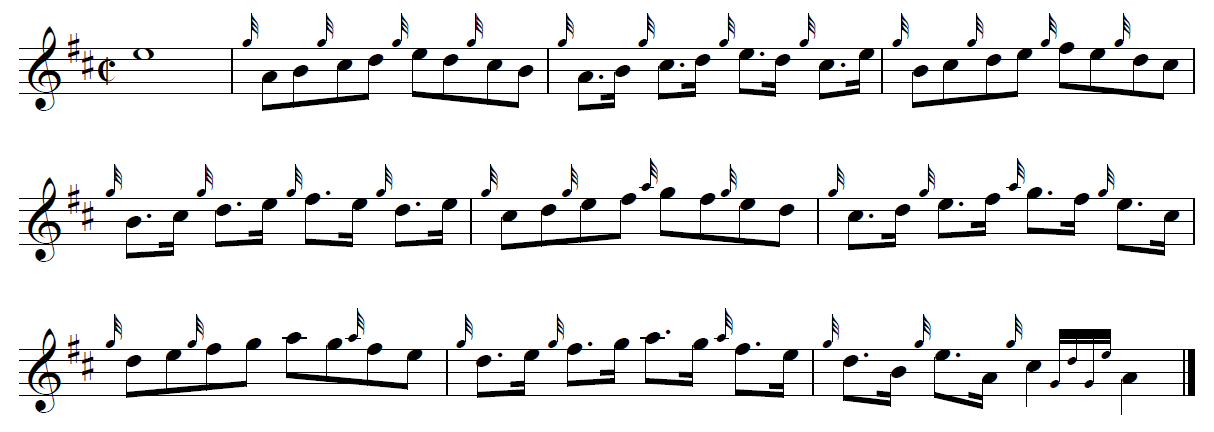
Five discussion points
1
The rhythm of the single gracenotes is very important in
this
tune. Making each eighth note same as each other is critical to getting
the effect of this tune which excites so many people, and this is
supported by making each gracenote the same length. The evenness of the
note durations gives the effect of playing quickly, even if you are
playing slowly. Listen very carefully to the midi files.
2 Low A doubling bar 1 - be careful to make sure that the D gracenote in the doubling is shorter than the other gracenotes, otherwise the tune will lose shape.
3 Hara in bar 2 - this has the same rhythm as the low A doubling in bar 1. You may wish to tap out this rhythm on the table a few thousand times to be sure of it. Also, keep telling yourself that the hara here is a kind of doubling - it might help to remember the function of embellishments...
4 Bar 4 low G gracenote to low A - this has the same timing as the high G gracenotes commented on in point one and for the same reason.
5 Bar 9 G gracenote to F from high A - this cannot be played and is clearly a proof-reading oversight by the RSPBA. The midi file omits this, and so should your band.
This section of the website has tunes taken from the Royal Scottish Pipe Band Asociation (RSPBA) prescribed tune list.
If you learn these tunes, there will be a large number of people you can be sure to find tunes in common with.
The RSPBA update their list from time to time and the versions here followed their original published versions, pending updates in due course.
These videos show the music and you can hear midi generated tracks where the rhythm of the gracenotes and embellishments is maintained in proper interprative proportion. You should try to feel the rhythm and also count it out exactly. Start with the fastest files and as you get better, go to the slower files, as this is a true measure of your security of technique.
Each file is given at two pitches, A and B flat. This reflects the different practice chanter tunings commonly found. Please scroll down to what you need (site updated for smart phone and tablets)
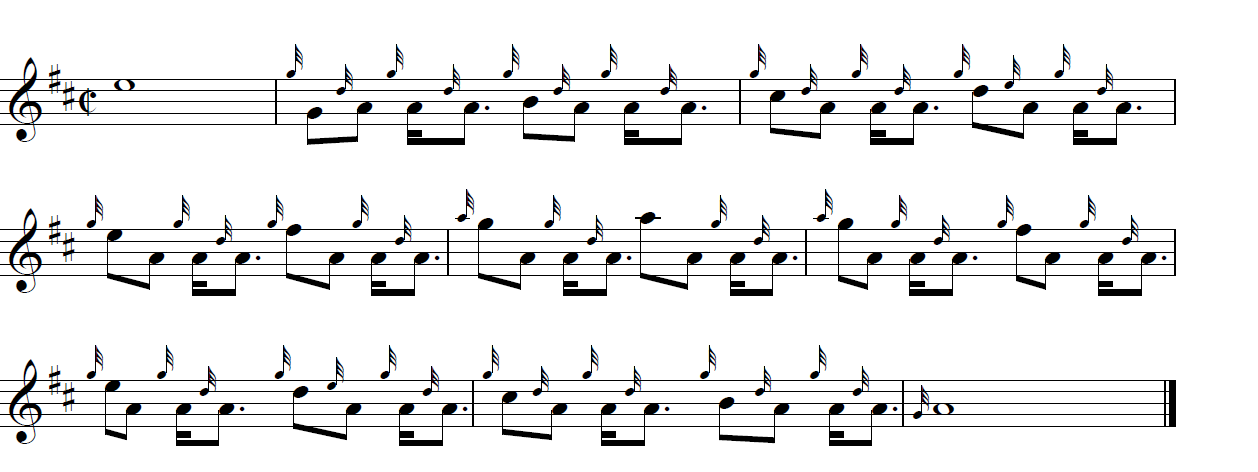
The exercises below are chosen to help with some particular trickiness in each tune.
Videos to play along with
| Low Pitch normal speed |
| Low Pitch half speed |
| Low Pitch quarter speed |
| High pitch normal speed |
| High pitch half speed |
| High pitch quarter speed |
To get more information and videos to play along with please follow the links for these exercises.
Five exercises
Exercise 1

Exercise 2

Exercise 3

Exercise 4
Exercise 5
howtodothings.com
Site map and contents
Youtube Channel
Clan Davidson Virtual Pipe Band
GHB Exercises
SSP Library
SSP Exercises
Medieval Music Library