Teach Yourself Bagpipes by Lindsay Davidson
bringing quality 'piping instruction to you for free| Select course Site entry page | How to practise | Highland Bagpipe library (+videos and hints) | Lindsay Davidson's tune library (scores only) | Smallpipe library | Medieval pipes library | Site map |
| Buy Lindsay's Books | ||||||
Gracenotes/dexterity

D Gracenotes

E gracenotes
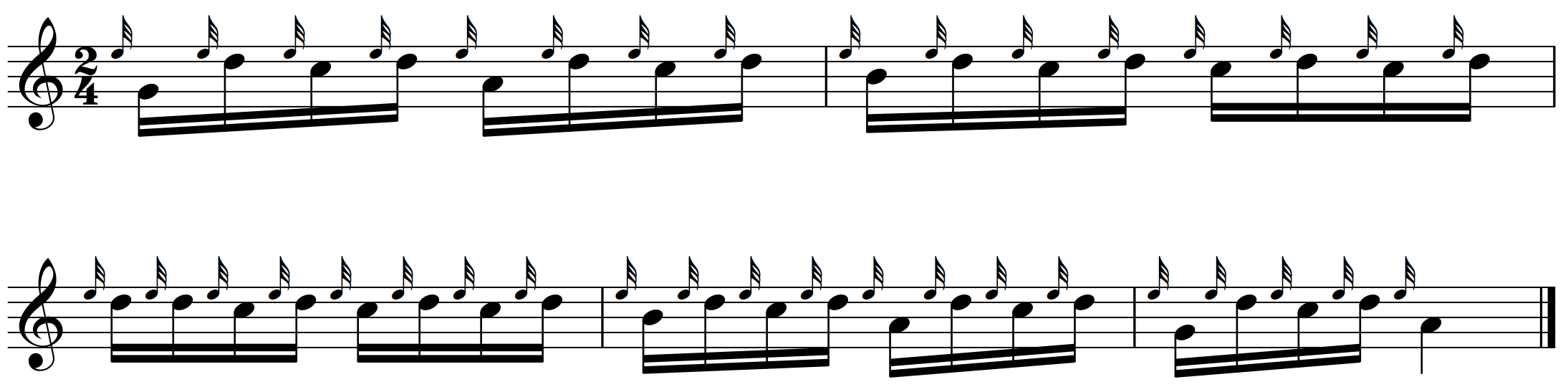
F gracenotes (for E doublings and later 'edre')
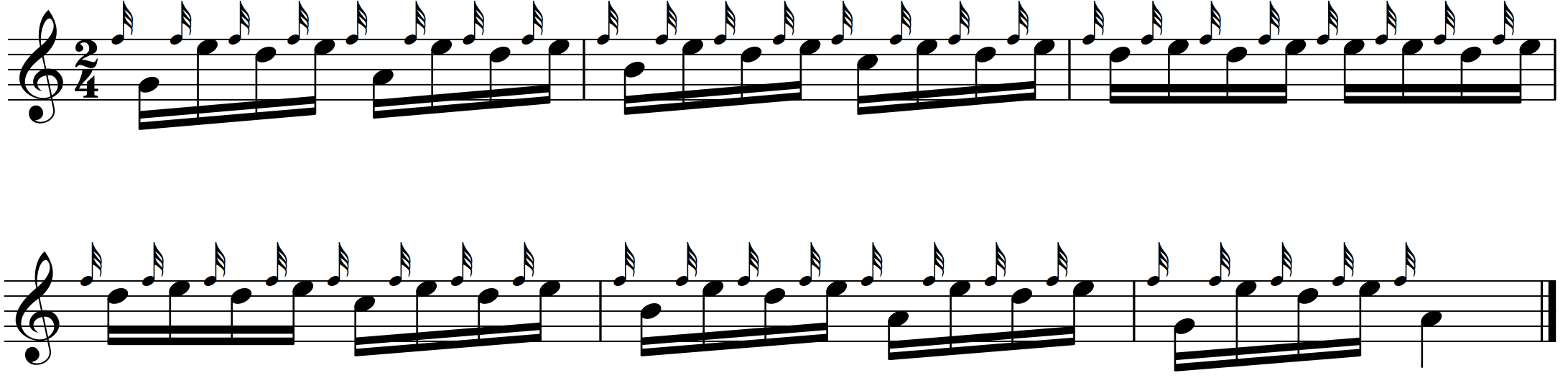
High G gracenotes

When you have achieved this, then comes the really tricky part....
Reverse your hands on the chanter!
The next important step is mental practice.
Torture....
It is right that these go together as we
will adress both issue at the same time.
Dexterity refers to both mental and digital dexterity - after all your brain tells your fingers what to do.
Stamina can also be brought in here. Using these exercises as templates, play two identical gracenotes instead of one before each note, for example, then three etc....
Please click on the links to go to pages where there are the exercises with videos to play along with.
C and F gracenotes (for bubbly notes, and independence of finger movements)Dexterity refers to both mental and digital dexterity - after all your brain tells your fingers what to do.
Stamina can also be brought in here. Using these exercises as templates, play two identical gracenotes instead of one before each note, for example, then three etc....
Please click on the links to go to pages where there are the exercises with videos to play along with.
D Gracenotes
E gracenotes
F gracenotes (for E doublings and later 'edre')
High G gracenotes
When you have achieved this, then comes the really tricky part....
Reverse your hands on the chanter!
This tests and works the conscious
connection between your mind and actions in the fingers. It will be hard, but
you'll be amazed how quickly you get on top of it. In short, if you do this, you
are well on your way to becoming a very strong piper. Please note, however,
these are INTERMEDIATE exercises, not for beginners. DO NOT ask yourself or
other beginners to swap hands until they are very secure and attempting to
challenge themselves and move up to the next level.
For even strength between the hands, combine swapped hands with the stamina exercises (playing each gracenote above two or three times) with these dexterity exercises.
For even strength between the hands, combine swapped hands with the stamina exercises (playing each gracenote above two or three times) with these dexterity exercises.
The next important step is mental practice.
Imagine you are at the shops, buying your
favourite thing... Then drive home, or walk home, in your mind's eye. That is,
imagine the whole trip from a known place (doing something you like) to another
known place (hopefully some place you like.).
Mental practice is the same thing. That is to say, if you can imagine your route and journey home, so you can run throgh an entire pipe tune in your mind and imagine your hands playing it correctly, in the same way.
This is also important as you build the mechanism of success in this way. In your mind's eye you can always get thigns right - by consciously bringing this image of success to the fore, you establish a greater likelihood you will actually play correctly. You are presdisposing yourself towards success.
It is like trying to travel from one village to another - if the road has been built it will be an easy and smooth ride, if not, it could be bumpy, uncomfortable and slower; build your road to sucess deliberately and carefully and you will make that journey from beginner to intermediate more easily and quicker.
Torture....
One more mental trick which can help is to
imagine a hot metal rod inserted all the way through your knuckles, vertical and
parallel to the chanter. Every time your hands stray from the correct position
on the chanter, this metal rod will burn your knuckles from the inside. This is
a brutal and agonising way of making sure that your practice is very effective.
Many pipers play with their arms and wrists moving around, and many of those who do this play very well. However, efficient practice is about identify which muscles need to be programmed and making sure that programming is as effective as possibe. By never moving your wrists and knuckles from the correct position in line with the front of the holes, you will always train the same muscles. Moving just a little puts your fingers in a different place and demands that you use other muscles. Logic says tran the same muscles all the time to get efficient results. There is actually a scientific set of answers which supports this position, but this is not the place to forward it (long story...).
Many pipers play with their arms and wrists moving around, and many of those who do this play very well. However, efficient practice is about identify which muscles need to be programmed and making sure that programming is as effective as possibe. By never moving your wrists and knuckles from the correct position in line with the front of the holes, you will always train the same muscles. Moving just a little puts your fingers in a different place and demands that you use other muscles. Logic says tran the same muscles all the time to get efficient results. There is actually a scientific set of answers which supports this position, but this is not the place to forward it (long story...).
howtodothings.com
Site map and contents
Youtube Channel
Clan Davidson Virtual Pipe Band
GHB Exercises
SSP Library
SSP Exercises
Medieval Music Library