Teach Yourself Bagpipes by Lindsay Davidson
bringing quality 'piping instruction to you for free| Select course Site entry page | How to practise | Highland Bagpipe library (+videos and hints) | Lindsay Davidson's tune library (scores only) | Smallpipe library | Medieval pipes library | Site map |
| Buy Lindsay's Books | ||||||
Cadences
'Cadence' as a musical term means a figure or formula which shows the end of a phrase, or sentence. This is also what it means in piobaireachd.
Strictly speaking we have the following figures known as cadences:
The E indicated as a small note in the group of gracenotes is typically around half of the length of the next note (marked as a crotchet or quarter note). In this case the emhpasis in your mind and when you sing comes on the crotchet.
Sometimes, depending on the musical context, it is the same length. In this case the emphasis in your mind and when you sing comes on the E.
The low G gracenote, you will notice, is marked as a semiquaver i(16th note) instead of the usual demi-semi-quaver (32nd note). You need to make it a little longer than is typical in light music (marches, strathspeys and jigs etc). If you try to make sure you can actually feel the low G and register it before opening it to Low A you will be fine.
| Notation | Canntaireachd word |
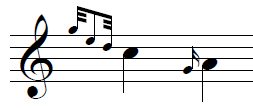 | hihodin |
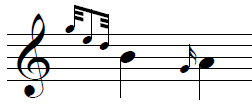 | hihiodin |
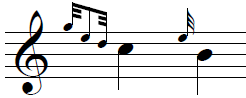 | hihoeo |
There is a further phrase which indicates the end of a sentence, but is
not called a cadence. This is 'hiharin', more historically described as
an 'echoing beat' or 'double echo' on low A. This is played like a normal birl,
preceded by a D gracenote. To do this, you simply open the D finger
when you close the E (or rather minimally before do that you don't get
a crossing sound). | |
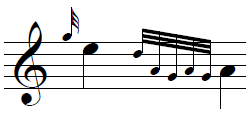 | hiharin |
howtodothings.com
Site map and contents
Youtube Channel
Clan Davidson Virtual Pipe Band
GHB Exercises
SSP Library
SSP Exercises
Medieval Music Library