RHYTHM AND READING MUSIC
Reading music is the same as
reading text. Notes have two basic values - pitch and duration.
These values are represented on a set of five lines called a “staff”
or “stave”. We learn about the
two values independently, and combine this knowledge when learning tunes.
NOTE NAMES
Notes are named using letters
from the alphabet. The pitch is
indicated by the vertical position of a note on the stave.
Every stave starts with a clef
- this indicates a reference note for us to read every other note from.
In ‘piping, we use a “G
Clef”. This is so named as the curly section of the clef goes around
the line which indicates the note called “G”.
Try
to remember the following rhyme to help remember the names:
Every
Good
Boy
Deserves
Fun
and then has a smiley FACE.
The highlighted letters in the
first half of the rhyme correspond with the names given to the lines (including
low E which is not used in piping) whilst those in
the second half corresponds with the names given to the spaces (including
low F which is not used in piping).
In pipe music,
some notes have tails going downwards and some going upwards.
The rule is that all gracenotes have tails going up and are not to be
included in the arithmetic of the bar. All
other notes (usually bigger) are melody notes and their total values added
together should give the number of beats of the specified type indicated in the
time signature (see below).
There
is a small flash applet which you open in a new window here. This will
give you 'flashcards' for learning to identify notes.
TIME VALUES
There are six common symbols
used to indicate duration of a note. These
symbols have a variety of names across the world, but the meaning of the symbols themselves are universal. The
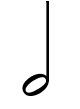
longest note, referred to as a “whole note” is called a semi-breve. By dividing
this systematically into two equal portions,
we get two notes, each
called a minum. We can also think
of these notes by their other name - half
notes, as they each take up
half as much time as the whole note.
From here, we move to filled in circles for the note heads, starting
with a crotchet (half of a minum,
and therefore, a quarter note, as
it is also a quarter of a semibreve). By
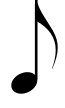
adding tails,
or cuts,
to notes, we half their
value. Tails are never added to
open circled note heads. Therefore,
a quaver, is half of a crotchet, or
an eighth note.
Keeping going, a semi-quaver,
looks like a crotchet with two tails, which means it is a crotchet halved
twice, giving it a value one
sixteenth of a whole note; thus
this is called a sixteenth note. A demi-semi-quaver,
is a thirty-second note.
Here are the notes in a table
(often called a 'note tree'):
|
1 Semibreve
| 
|
takes up the same amount of
time as
|
|
2 Minims
| 
|
takes up the same amount of
time as
|
|
4 Crotchets
| 
|
takes up the same amount of
time as
|
|
8 Quavers
| 
|
takes up the same amount of
time as
|
|
16 Semi-Quavers
| 
|
takes up the same amount of
time as
|
|
32
Demi-Semi-Quavers
| 
|
|
Adding
a dot onto a note increases its value by one half.
Adding a tail halves the value of the note
(i.e quaver + dot = 3 semi-quavers).
A BAR
is the space between the vertical lines on the stave. This was first used to
make rehearsal easier by dividing the music into easily readable sections containing the same number of beats.
At the start of a tune there
are two numbers, one above the
other like a fraction. This is
called a TIME SIGNATURE and tells the
player how many beats there are in a bar.
The top number tells how many beats and the bottom number indicates the
type of beats. If the number on the
bottom is 4, then the beats are all
quarter notes (crotchets) and if it is 8 then they are eighth notes (quavers)
etc.
When
reading music, careful to make sure that every beat lasts the same amount of
time as every other beat, and that notes which are the same have the same amount
of time (i.e. quavers last the same amount of time as other quavers)
There are many many explanations about how to read music on youtube and elsewhere on the internet.
Here is a small list which may be helpful:
Visual Music Minds channel - https://www.youtube.com/channel/UCjUxQg9cHiOYqaRdtZ6pfoQ
Mrs Musical Pants - https://www.youtube.com/channel/UCcueqsFShdlJ3tmeKhC0yMA
Music wth no pain - https://www.youtube.com/c/musicwithnopain/featured
Lindsay Davidson has no affiliation with these - they are just helpful.
