
This tune was composed as part of a collection of 53 jigs for beginners available via Amazon.
The 'easiness' of these tunes is based upon using a small number of repeating patterns in each, a limited range and low density of gracenotes and embellishments, simple musical language and avoiding tricky crossing sounds and rhythmical patterns.
There must have been a reason for the tune gaining this title, but the composer can't remember...
As can be seen from the colour coded version below, there are very few (only 6!) patterns to train into the fingers to get on top of this tune.
Each boxed phrase should be trained thoroughly 7 times in a row using the method in step 1 below.
Each boxed phrase should be taken slowly and perfectly, and even before trying to put the tune together, speed each phrase up as fast as it will go. This way the learner will gain some fluency.
Once each of the six boxed phrases is done and fluent and fast(ish), then join each 8 bar section up as a whole section, going from the start of each bar to the start of each next bar, again 7 times without mistakes using the trick suggested below in step 2.
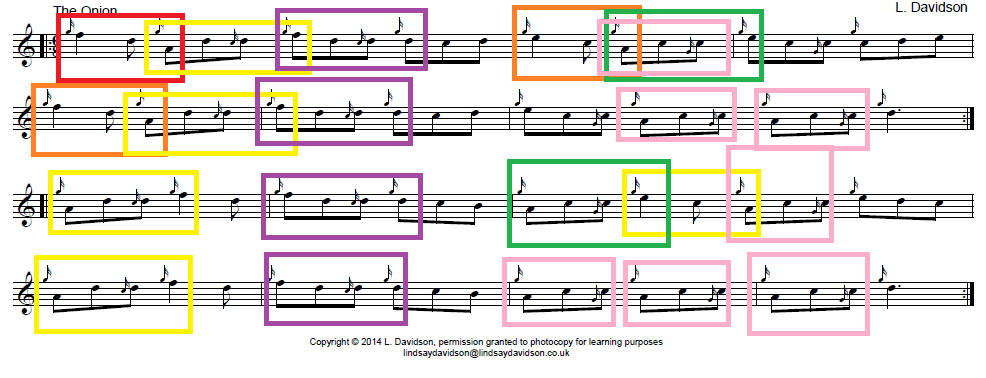
Step 1 will be to programme each coloured fragment below into the hands using the 5 steps and 7 coins method. This is also described here.
Step 2 is to train your 'thinking blocks'. This means plan everything you need to do from the first note in one bar to the first note in the next bar and then play it. Before moving on to the following bar and action do the planning. This way you learn to stop and think on the heavy beats, instead of the places where you shouldn't stop.
Step 3 is to make the first note in every bar appear at a regular time interva and the last step is to speed up.
Thinking in blocks is a vital tool to acquire when learning how to speed up and manage performances as a practising musician.
Videos to play along with
High pitch normal speed
High pitch half speed
Low pitch normal speed
Low pitch half speed