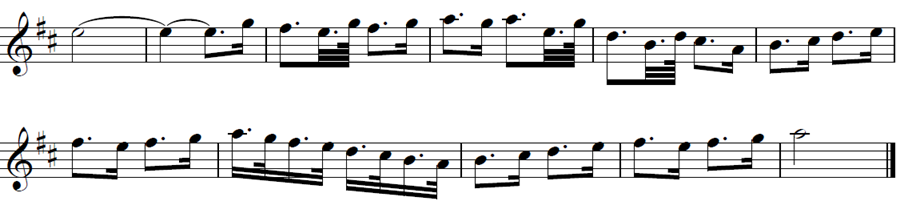
1 All the gracenotes are the same length as each other, 64th notes. This includes the cuts in the doublings.
2 The strikes are also 64th notes.
3 Bars 2 has a rhythmical feature of two 16th notes
next to each other, the note before the tachum and the tachum itself. A
rhythmical interpretation trick here given by the author's teacher,
Jimmy Inglis, is to hold on the first 16th note a little longer,
meaning the time for that is taken from the preceding note to that, and
treat the second note as written. The effect is like a platform on the
B to give extra force to the cutting of the C (tachum). The rhythm for
this motif (A:B) is as a triplet in the proportion 2:1. As ever, listen
carefully to the slow videos to get the best feel for this. Remember
the meaningful action is the triplet A to B before the tachum.
4 This rhythmical interpretation has not been applied to
all instances of two short notes together. This is deliberate and
provides interpretative variety.
5 All of the gracenotes, including strikes close on the beat or subdivision smaller than that.
6 The tachum has a D gracenote that is shorter than the C.
This is not always the case, in the interpretative style taught by the
author's teacher.
Videos to play along with
Low Pitch Normal Speed
Low Pitch Half Speed
Low Pitch Quarter Speed
High Pitch Normal Speed
High Pitch Half Speed
High Pitch Quarter Speed
Exercises (click on the links to get more detailed instructions and videos to play along with)