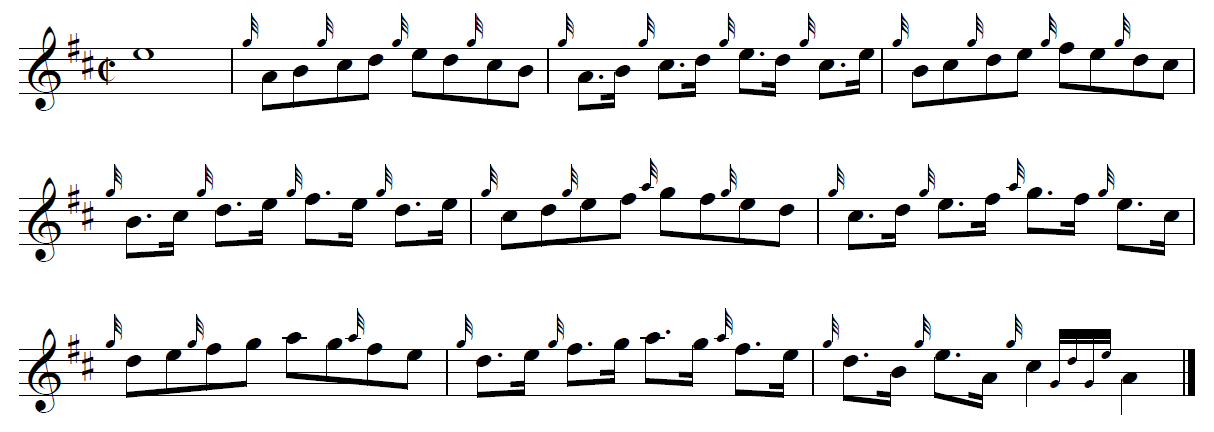
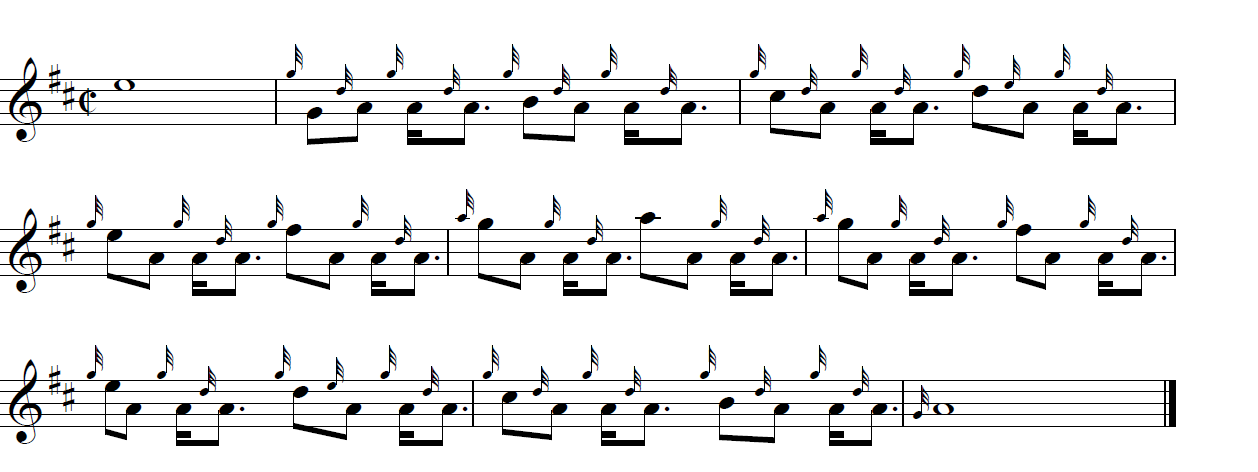
This is from the RSPBA selection of set tunes for competitions. Their
version has been taken for compiance with their competitions.
Five discussion
points
1
The rhythm of the single gracenotes is very important in
this
tune. Making each eighth note same as each other is critical to getting
the effect of this tune which excites so many people, and this is
supported by making each gracenote the same length. The evenness of the
note durations gives the effect of playing quickly, even if you are
playing slowly. Listen very carefully to the midi files.
2
Low A doubling bar 1 - be careful to make sure that the D gracenote in
the doubling is shorter than the other gracenotes, otherwise the tune
will lose shape.
3 Hara in bar 2 - this has the same rhythm
as the low A doubling in bar 1. You may wish to tap out this rhythm on
the table a few thousand times to be sure of it. Also, keep telling
yourself that the hara here is a kind of doubling - it might help to
remember the function of embellishments...
4 Bar 4 low G
gracenote to low A - this has the same timing as the high G gracenotes
commented on in point one and for the same reason.
5 Bar 9 G
gracenote to F from high A - this cannot be played and is clearly a
proof-reading oversight by the RSPBA. The midi file omits this, and so
should your band.
The exercises below are chosen to help with some particular trickiness in each tune.
Videos to play along with
Low Pitch normal speed
Low Pitch half speed
Low Pitch quarter speed
High pitch normal speed
High pitch half speed
High pitch quarter speed
To get more information and videos to play along with please follow the links for these exercises.