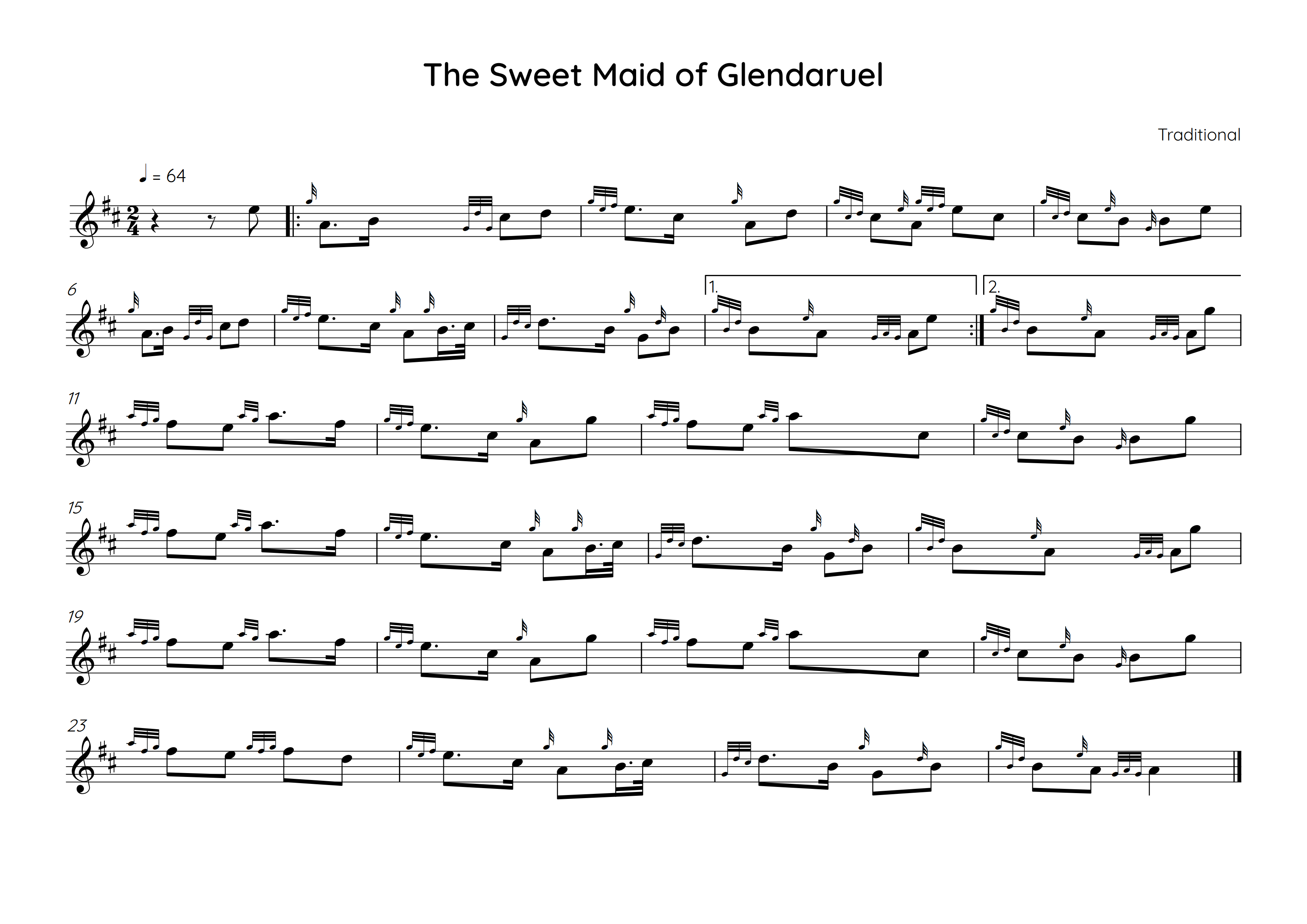
A lovely, bright and simple wee tune.
Give it some joy when you play it. There are several ways to embellish
this tune, all of which may be correct according to their own logic. If
someone in your band or friend group knows this tune already and plays
it differently, it is not worth arguing about.
1 The grip at the beginning is just like in The Green Hills and When the Battle's O'er. The B is divided into three equal parts, the first third is given to the B and the next two thirds each have a low G, with a very short D gracenote cutting between them (proportion 3:1:4 if you want to listen carefully to that carefully on the videos slowly). This is the case for every grip.
2 The high G gracenotes are 64th notes, except for bar 7 in each part, where it needs to be lighter and thus shorter (a 128th note)
3 The doublings fit into the shape that the note is repeated (or 'doubled') after a 32nd note. This means the gracenote doing the cutting or doubling is one quarter of a 32nd note, and preceded by a note three times its length. These are horribly clumsy words for a fairly simple idea (New French Method word is Ta-fi)
4 The E gracenotes are also 64th notes.
5 The B strikes are also 64th notes, opening on the beat.
6 The throws all share the same characteristic of taking half the preceding short C and giving it to the low G, then opening the D on the beat and a very light tap making the second D sound a 64th note after the beat.
7 The birl is quite open, only giving the first repeat of the low A a 32nd note before the beat. This helps prevent the tune from galloping away in tempo.
This is a great place to think about the two ways that pipe music is made to happen. We have the perceived sounds (I call this active rhythm) and the things which go on in shorter gracenotes to make this effect happen (I call this passive, though it is far from being passive as this is where your true technique comes out). These tiny gracenotes are basically the strikes and the cuts which double other notes. Some strikes belong to the active sounds.
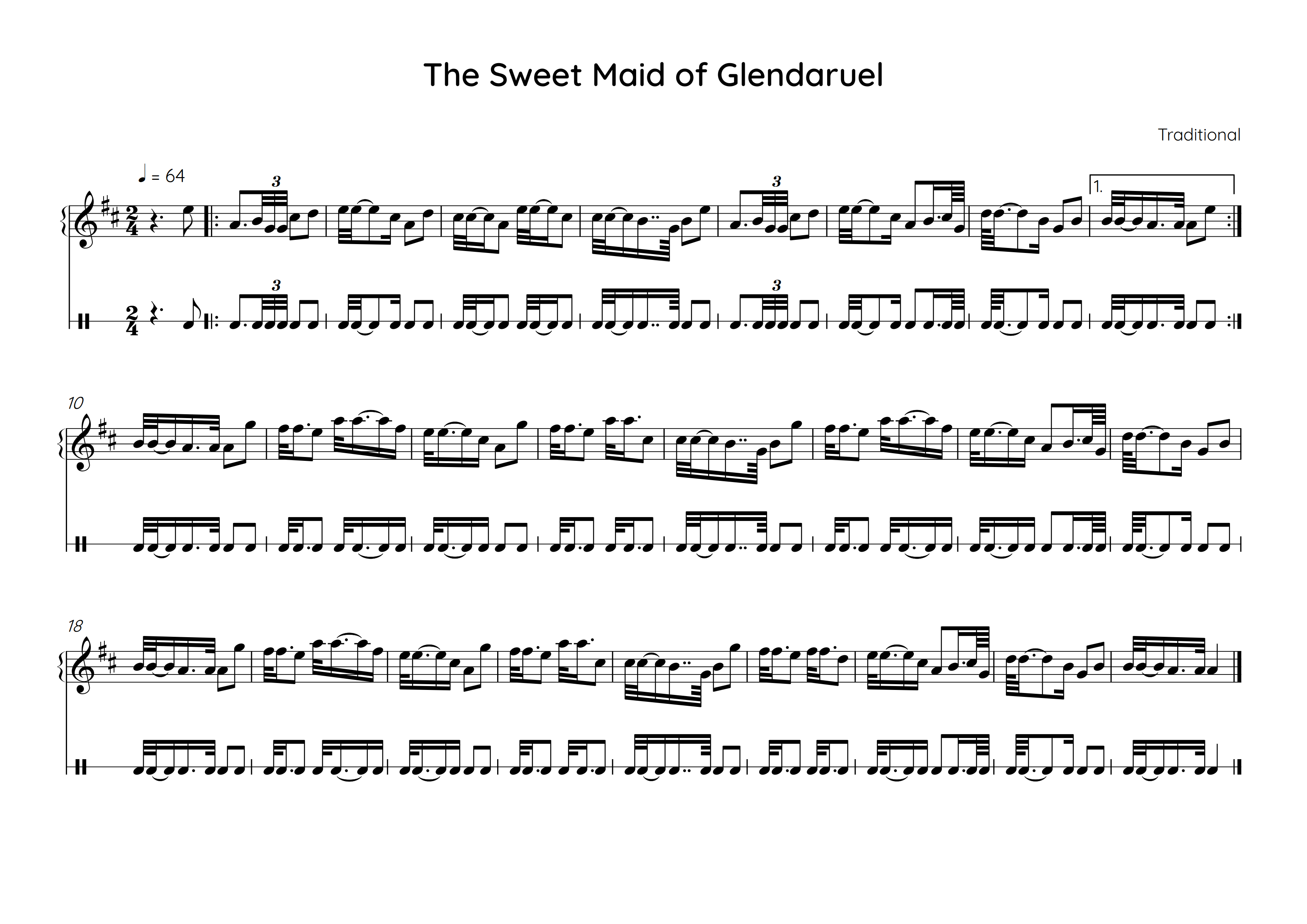
This tune's active (meaning not passive) rhythm is given below. This what your listen should think they hear and if a musicologist were to write down what they hear from your playing, this is what they should get!
There are two lines of music - one as the pitches, and one just as the rhythm. You could practice this in a group tapping out this rhythm together on the table.
1 The grip at the beginning is just like in The Green Hills and When the Battle's O'er. The B is divided into three equal parts, the first third is given to the B and the next two thirds each have a low G, with a very short D gracenote cutting between them (proportion 3:1:4 if you want to listen carefully to that carefully on the videos slowly). This is the case for every grip.
2 The high G gracenotes are 64th notes, except for bar 7 in each part, where it needs to be lighter and thus shorter (a 128th note)
3 The doublings fit into the shape that the note is repeated (or 'doubled') after a 32nd note. This means the gracenote doing the cutting or doubling is one quarter of a 32nd note, and preceded by a note three times its length. These are horribly clumsy words for a fairly simple idea (New French Method word is Ta-fi)
4 The E gracenotes are also 64th notes.
5 The B strikes are also 64th notes, opening on the beat.
6 The throws all share the same characteristic of taking half the preceding short C and giving it to the low G, then opening the D on the beat and a very light tap making the second D sound a 64th note after the beat.
7 The birl is quite open, only giving the first repeat of the low A a 32nd note before the beat. This helps prevent the tune from galloping away in tempo.
This is a great place to think about the two ways that pipe music is made to happen. We have the perceived sounds (I call this active rhythm) and the things which go on in shorter gracenotes to make this effect happen (I call this passive, though it is far from being passive as this is where your true technique comes out). These tiny gracenotes are basically the strikes and the cuts which double other notes. Some strikes belong to the active sounds.
This tune's active (meaning not passive) rhythm is given below. This what your listen should think they hear and if a musicologist were to write down what they hear from your playing, this is what they should get!
There are two lines of music - one as the pitches, and one just as the rhythm. You could practice this in a group tapping out this rhythm together on the table.
Videos to play along with (exercsises below)
Low pitch normal speed
Low pitch half speed
Low pitch quarter speed
High pitch normal speed
High pitch half speed
High pitch quarter speed
Exercises (click on the links to go to pages with more information and videos to play along with)
Exercise 1

Exercise 2

Exercise 3

Exercise 4

Exercise 5

Low pitch normal speed
Low pitch half speed
Low pitch quarter speed
High pitch normal speed
High pitch half speed
High pitch quarter speed
Exercises (click on the links to go to pages with more information and videos to play along with)
Exercise 1
Exercise 2
Exercise 3
Exercise 4
Exercise 5