Learning tips
1 This is
one of those tunes...it is incredibly joyful, attractive and pleasant
to listen to...if you can just get the underlying active rhythm to come
across cleanly. The sound of the 'active' elements, the things a
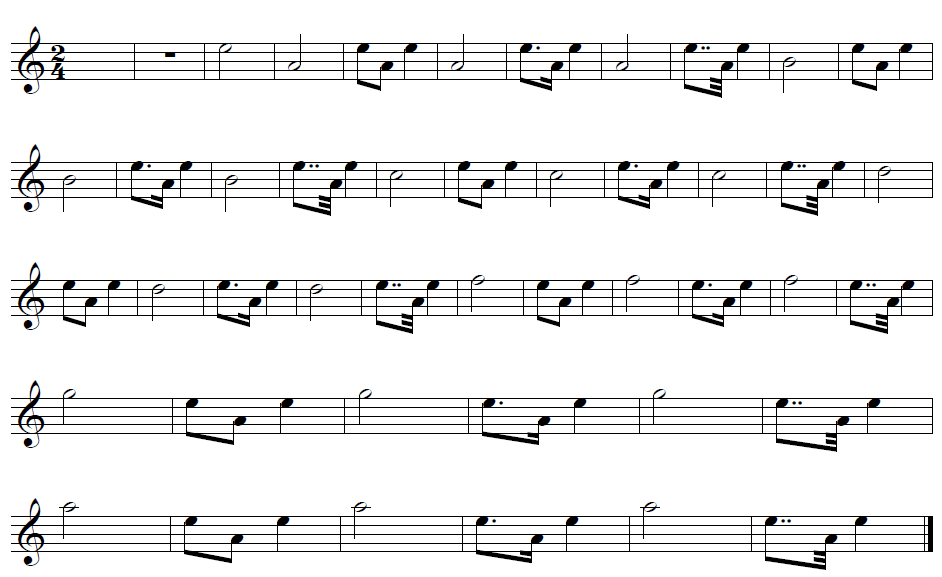
musicologist would write down as a dictation of the melody, are below,
and to aid understanding this, a video is also included. The harp sound
has been chosen as it is soft, and shows the repetitions of the notes
very clearly.
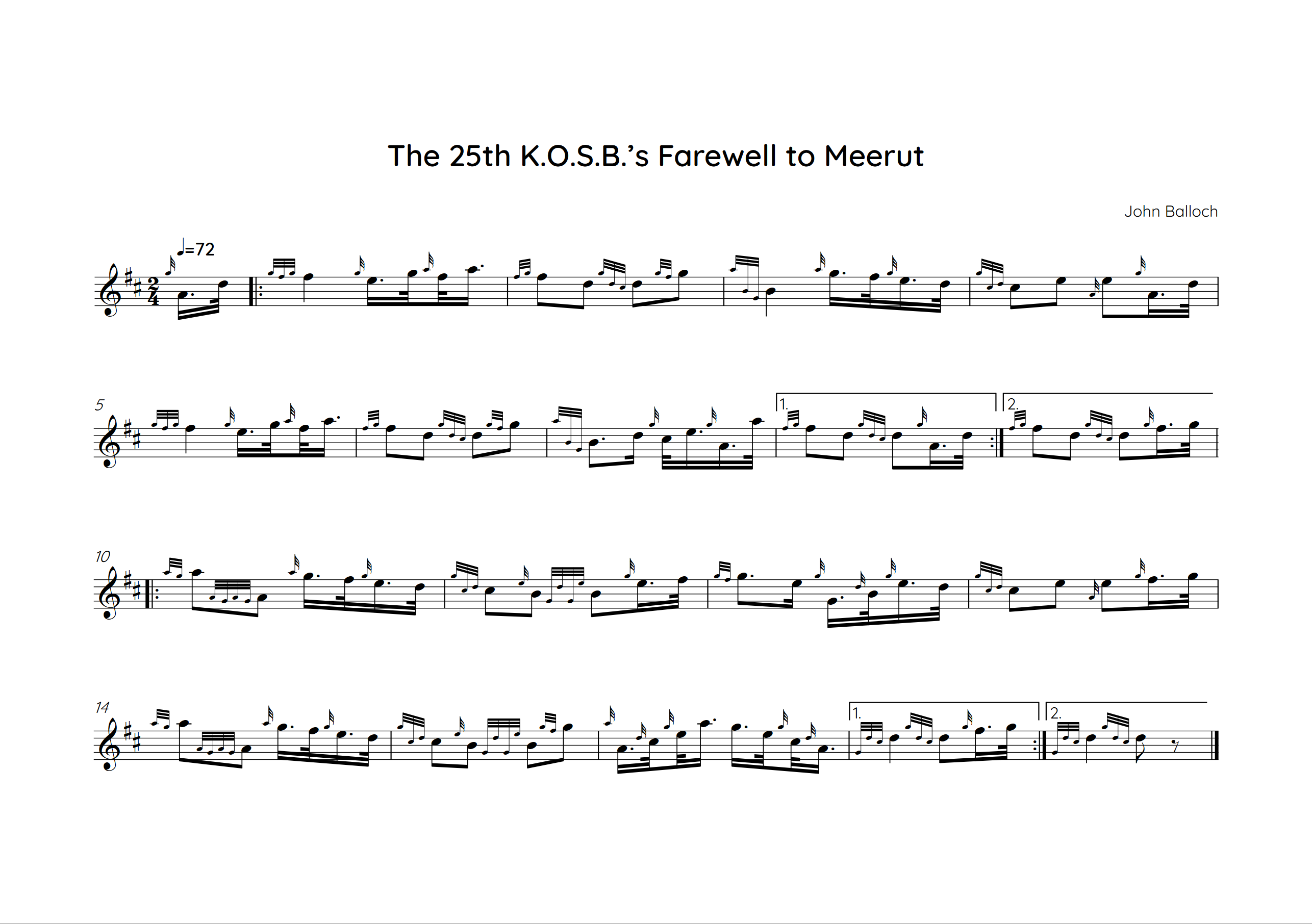
2 The high G gracenotes go between two lengths here. The first G gracenote is a third of the D preceding it. This is to gie shape and clarity in contrast to the next G gracenote, which 'cuts' or doubles the F in the doubling.
3 There is an interpretative decision where there are two 32nd notes next to each other; in every such situation the first 32nd note is a little longer and the second is as per given value. This provides extra bounce and beauty to the tune. The notation makes this very clear and shows the proportion used for this.
4 Highland Laddie has a similar solution to this tune when it comes to the last beat of bar 3. If you say the words "bouncy bouncy" for the 'GFED' dotted and cut scale...you will not only fee silly (make fun of yourself to make it less bad..) but you will give an appropriate bounce and lightness of touch to the tune. This means the G gracenotes are treated as a third of the preceding 32nd note (and it is made into a 64th note triplet with the main note then being to 64th notes tied together and the gracenote being the remaining third, as a consequence). Listen carefully to get this, and also learn Highland Laddie.
5 The 'hara' opens on the beat, but the B doubled with a strike immediately afterwards has the first B on the beat. The 'hara' G gracenote is a 64th note, while the strike is 128th note.
6 Keep the strikes in the High G and High A doublings super light, just tapping the fingers on the chanter and not measuring the movements.
7 The tachum at the end features a trick taught by P/M Jimmy Inglis of Polmont. The C and the D gracenotes are of equal length. This is a stylistic question taught by Auld Jimmy, and in this situation is extremely practical and sensible.
8 The throw at the end has a 32nd note low G that comes before the beat. This gives strong structure and a final flourish to close the part and the tune.
Here is a video showing the 'active' elements of the interpretation of the elements. This is what the gracenotes are supposed to outline and make the listener hear. A harp sound has been used in order to make the repetitions more clear than they would be otherwise.
Videos to play along with (exercises below)
Low pitch normal speed
Low pitch half speed
Low pitch quarter speed
Low pitch normal speed
Low pitch half speed
Low pitch quarter speed


2 The high G gracenotes go between two lengths here. The first G gracenote is a third of the D preceding it. This is to gie shape and clarity in contrast to the next G gracenote, which 'cuts' or doubles the F in the doubling.
3 There is an interpretative decision where there are two 32nd notes next to each other; in every such situation the first 32nd note is a little longer and the second is as per given value. This provides extra bounce and beauty to the tune. The notation makes this very clear and shows the proportion used for this.
4 Highland Laddie has a similar solution to this tune when it comes to the last beat of bar 3. If you say the words "bouncy bouncy" for the 'GFED' dotted and cut scale...you will not only fee silly (make fun of yourself to make it less bad..) but you will give an appropriate bounce and lightness of touch to the tune. This means the G gracenotes are treated as a third of the preceding 32nd note (and it is made into a 64th note triplet with the main note then being to 64th notes tied together and the gracenote being the remaining third, as a consequence). Listen carefully to get this, and also learn Highland Laddie.
5 The 'hara' opens on the beat, but the B doubled with a strike immediately afterwards has the first B on the beat. The 'hara' G gracenote is a 64th note, while the strike is 128th note.
6 Keep the strikes in the High G and High A doublings super light, just tapping the fingers on the chanter and not measuring the movements.
7 The tachum at the end features a trick taught by P/M Jimmy Inglis of Polmont. The C and the D gracenotes are of equal length. This is a stylistic question taught by Auld Jimmy, and in this situation is extremely practical and sensible.
8 The throw at the end has a 32nd note low G that comes before the beat. This gives strong structure and a final flourish to close the part and the tune.
Here is a video showing the 'active' elements of the interpretation of the elements. This is what the gracenotes are supposed to outline and make the listener hear. A harp sound has been used in order to make the repetitions more clear than they would be otherwise.
Videos to play along with (exercises below)
Low pitch normal speed
Low pitch half speed
Low pitch quarter speed
Low pitch normal speed
Low pitch half speed
Low pitch quarter speed
Five exercises - follow the links for more information and videos to play along with
