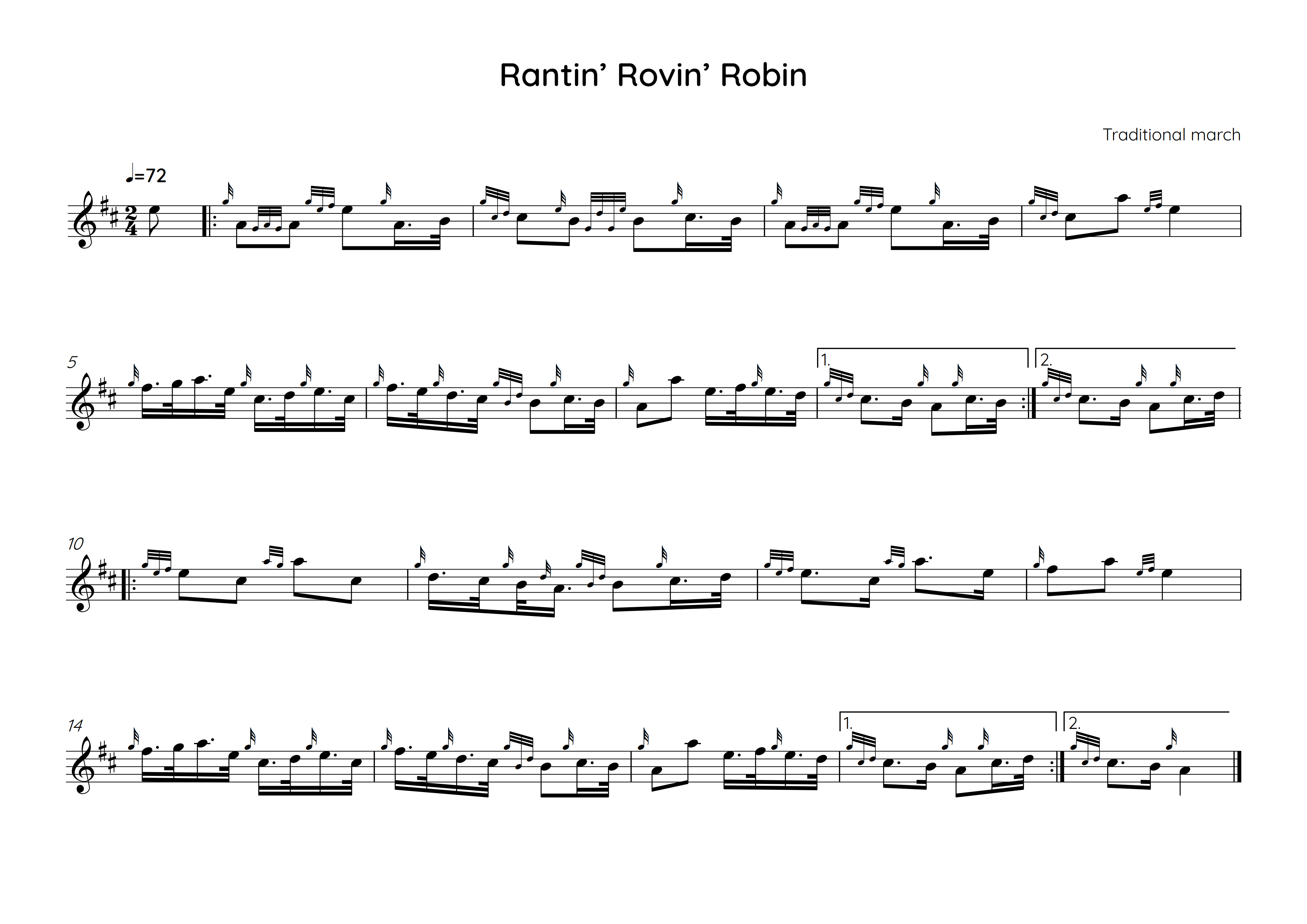
1 The birl is crisp and short, taking up the space of
a mere 32nd note in total. This is not as difficult to play as it
sounds, but it is good to listen carefully to the videos.
2 High G gracenotes between notes are mostly 64th
notes, but where the preceding note is a 32nd note (B at the end of bar
1 for example), the triplet solution is used, similar to the
interpretation in Highland Laddie.
3 In the doublings (except High A), the note being
doubled is repeated one 32nd note after the beat. This is refreshing
and crisp, and highly rhythmical.
4 The High A doubling, the A is repeated one 64th
note after the beat. Don't measure your thumb action, just strike it
off the chanter in the correct place/moment.
5 The two 32nd notes next to each other have an
interpretation trick taught by Jimmy Inglis of Polmont - hold on the
first of those two notes slightly longer and use that as a platform to
give sharpness and cut to the second. Here it is measured as a triplet
for the first half of the beat, and the second half is played as
written.
6 There may be moments in this tune where you will
want to 'corrupt' the given time by introducing tiny pauses, like
taking a breath in speaking. One place for example would be bar 11
after the B doubling. Remember that the principle is that playing any
instrument is about moving your fingers up and down in a certain order
in a certain time; the order is technique and the time is music and
when you corrupt the time you make that music personal. Th e purpose of
all of this is to give you the technical flexibility to do whatever you
want in corrupting time. (hint - it is just about adding tiny pauses
here and there, or stretching and shrinking beats in a rubato effect).