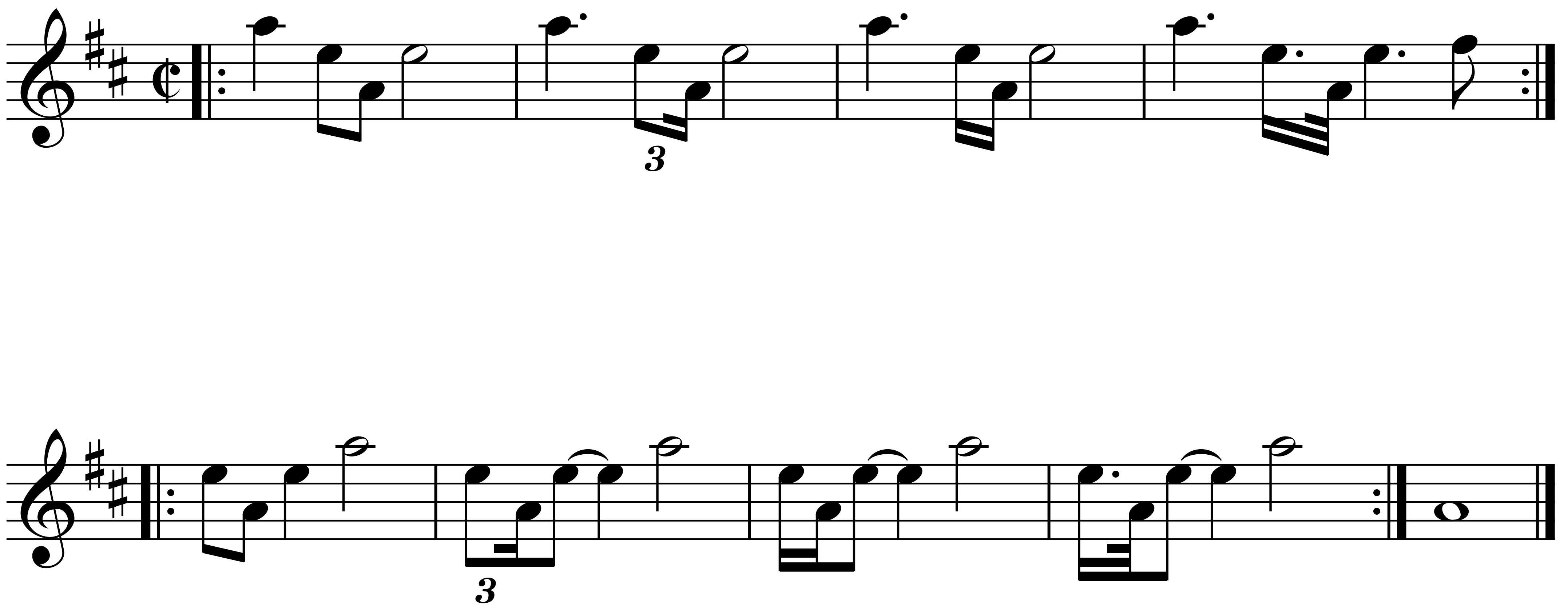
This
exercise is intended to help with E strikes. Make sure you are very
aware of the rhythms you are playing, as this is the whole point. This
exercise and its format can be adapted to all strikes and as such will
cover all possible case scenarios you could come across in tunes.
How to practise
Solid bagpipe technique is not about being able to squeeze more wiggly bits into an ever smaller space of time. Solid bagpipe technique means that you can choose how long or short every finger movement will be (and why, according to your physical situation and musical interpretation), and the actions come out as exactly you want. These exercises are designed to make this happen, to give you total awareness and control over your embellishment rhythm by helping establish patterns in your brain.
The Magic Maxim:
"If you can play slowly you can play quickly, but the converse isn't necessarily true..."
This means exactly what it says - the better you become the more exactly you should be able to control what you are doing, and so to test ourselves, we shouldn't practise more quickly, but more slowly.
To think like computers - a sampling rate for a recording is a measure of how many times a second the computer will measure what is happening in the sound. A higher sampling rate makes for a higher quality of recording, up to a point beyond which it doesn't make much difference. It is the same with piping - the more times in a beat you can say exactly what is happening, the better your piping, up to a point..
Playing exactly with the midi files at a quarter speed is a fairly good test for a group, and this extra secret can dramatically affect the strength of playing within a band, and the confidence. It is true that using this approach, you can bring about a positive revolution in your band's playing and attitude.
So to repeat, as you get better and your finger and rhythmical control become more exact, you should go from the fastest videos...to the slowest.
Videos to play along with
Low Pitch Normal Speed
Low Pitch Half Speed
Low Pitch Quarter Speed
High Pitch Normal Speed
High Pitch Half Speed
High Pitch Quarter Speed
Low Pitch Normal Speed
Low Pitch Half Speed
Low Pitch Quarter Speed
High Pitch Normal Speed
High Pitch Half Speed
High Pitch Quarter Speed