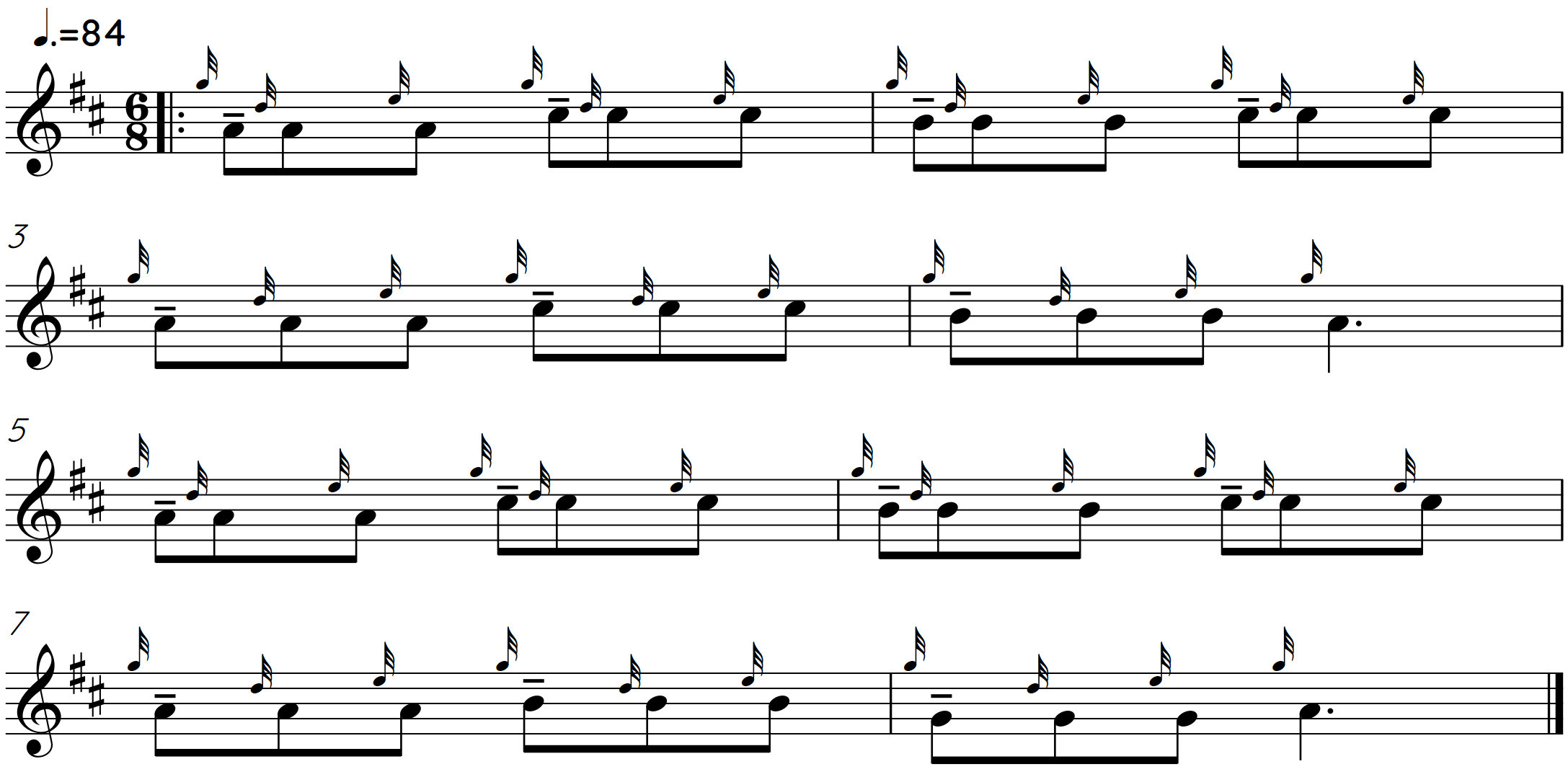
This exercise is designed
to help you develop a specific rhythmical interpretation trick. You
will often hear in traditional Scottish and Irish jigs that the eighth
notes are not all even...This is style, and people apply it at will and
when they feel like it.
Remember, good technique is not about squashing ever more twiddly bits into and ever small amount of space (thrilling and tempting though that may be...), it is about being able to make your fingers do anything you want whenever you want, and getting the response from your fingers that you are looking for.
The famous and incredibly accomplished Belgian piper Remi Decker gave Lindsay the key trick to explaining this interpretative point. Remi said he picked this up by speaking to people. When you are aiming to play this rhythm, say "Yappity yappity" to yourself, and play the notes in that time. It works. If you are not inclined to linguistic ways of learning, the mathematical reality (not for everyone either) is that the first note has half a dot added (yes...half a dot!). This has been shown in the music by a line above the note. You will not see this in normal pipe notation., but you may wish to add this when you are making your own interpretations.
This rhythmical trick will not really be helpful for beginners, which is why it is in the intermediate area of the materials. It is important not to introduce too many elements too early, as doing so could cause confusion.
You should do this exercise from the half speed videos, then go to the slowest, before the fastest versions which are designed to be like speech, and you will also need to consider switching the methods by which you think as you change speed - from yappity yappity to mathematical, and 'feeling' the rhythm.
This is a tough one, but once you have mastered it, you can interpret any jig you want, at any time and in any way.
The Magic Maxim:
"If you can play slowly you can play quickly, but the converse isn't necessarily true..."
This means exactly what it says - the better you become the more exactly you should be able to control what you are doing, and so to test ourselves, we shouldn't practise more quickly, but more slowly.
To think like computers - a sampling rate for a recording is a measure of how many times a second the computer will measure what is happening in the sound. A higher sampling rate makes for a higher quality of recording, up to a point beyond which it doesn't make much difference. It is the same with piping - the more times in a beat you can say exactly what is happening, the better your piping, up to a point..
Playing exactly with the midi files at a quarter speed is a fairly good test for a group, and this extra secret can dramatically affect the strength of playing within a band, and the confidence. It is true that using this approach, you can bring about a positive revolution in your band's playing and attitude.
Videos to play along with (Exercises below)
Low Pitch Normal Speed
Low Pitch Half Speed
Low Pitch Quarter Speed
High Pitch Normal Speed
High Pitch Half Speed
High Pitch Quarter Speed
Low Pitch Normal Speed
Low Pitch Half Speed
Low Pitch Quarter Speed
High Pitch Normal Speed
High Pitch Half Speed
High Pitch Quarter Speed