
This tune was composed as part of a collection of 53 jigs for beginners available via Amazon.
The 'easiness' of these tunes is based upon using a small number of repeating patterns in each, a limited range and low density of gracenotes and embellishments, simple musical language and avoiding tricky crossing sounds and rhythmical patterns.
In 2014 Lindsay had a trip to perform a concert with Marek Stefanski (organ) in Kalingrad, Russia. It was a delightful and worthwhile trip and filled with interesting and possitive experiences. The concert took place in a church that had been converted into a concert hall. This church had been frequented by Helmholtz, Wagner, Nietzsche, E.T.A. Hoffmann, and Immanuel Kant amongst others. It was quite inspiring to sit quietly during rehearsals listening to the others and thinking who else might have sat in the same place and thought quietly to themselves.
As can be seen from the colour coded version below, there are very few patterns to train into the fingers to get on top of this tune.
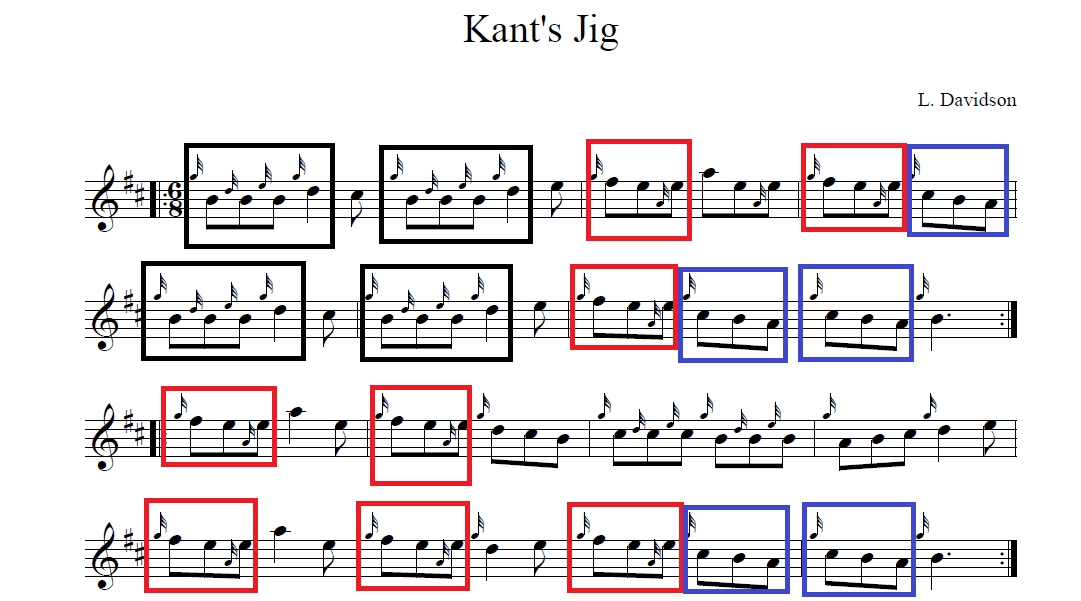
Step 1 will be to programme each coloured fragment below into the hands using the 5 steps and 7 coins method. This is also described here.
Step 2 is to train your 'thinking blocks'. This means plan everything you need to do from the first note in one bar to the first note in the next bar and then play it. Before moving on to the following bar and action do the planning. This way you learn to stop and think on the heavy beats, instead of the places where you shouldn't stop.
Step 3 is to make the first note in every bar appear at a regular time interval and the last step is to speed up.
Thinking in blocks is a vital tool to acquire when learning how to speed up and manage performances as a practising musician.
The 'easiness' of these tunes is based upon using a small number of repeating patterns in each, a limited range and low density of gracenotes and embellishments, simple musical language and avoiding tricky crossing sounds and rhythmical patterns.
In 2014 Lindsay had a trip to perform a concert with Marek Stefanski (organ) in Kalingrad, Russia. It was a delightful and worthwhile trip and filled with interesting and possitive experiences. The concert took place in a church that had been converted into a concert hall. This church had been frequented by Helmholtz, Wagner, Nietzsche, E.T.A. Hoffmann, and Immanuel Kant amongst others. It was quite inspiring to sit quietly during rehearsals listening to the others and thinking who else might have sat in the same place and thought quietly to themselves.
As can be seen from the colour coded version below, there are very few patterns to train into the fingers to get on top of this tune.
Step 2 is to train your 'thinking blocks'. This means plan everything you need to do from the first note in one bar to the first note in the next bar and then play it. Before moving on to the following bar and action do the planning. This way you learn to stop and think on the heavy beats, instead of the places where you shouldn't stop.
Step 3 is to make the first note in every bar appear at a regular time interval and the last step is to speed up.
Thinking in blocks is a vital tool to acquire when learning how to speed up and manage performances as a practising musician.
Videos to play along with (with a two-bar introduction and harp accompaniment instead of metronome)
Please use the youtube settings to slow down to 75% if you need (more sounds bad)
Please use the youtube settings to slow down to 75% if you need (more sounds bad)
High pitch normal speed
High pitch half speed
Low pitch normal speed
Low pitch half speed
Exercises to help develop at this level (click on links for pages and videos)
Exercise 1
General dexterity...
Exercise 2

Exercise 3

Exercise 4

Exercise 5
