As
bagpipes make a continuous sound at one level (very loud), it means
we need a special way to emphasise notes and also a way to repeat
notes. Gracenotes
have these two functions - to cut a note into smaller pieces and to
emphasise a change from one note to another. They are short
'chirping' sounds.
Strikes
are another way of repeating a note.
When
emphasising transition between notes, most gracenotes open before the
beat and close on the beat.
Likewise,
when repeating notes, both gracenotes and strikes typically open
before the beat and close on the beat. The time taken by the
gracenote or strike takes defines how big an effect or how strong the
emphasis is.
The
length of a gracenote or a strike depends on musical factors. It is a
question of interpretation. In the advanced
areas of learning you will have the opportunity to train the
relative length of gracenotes and strikes.
Above
are links to each common gracenote, together with an explanation and
a series of exercises to develop skills.
Below
are exercises to help you know you are ready to move on to the next
area.
If
you can play along with the video for each of the six exercises
below, then you are ready to go to the next topic, throws.
Exercise 1
Use the how to practise instructions and go through the five steps, speeding up so that you can play along with the video.
As chanters can often sound very different and be out of tune, there are two versions - high pitch and low pitch.
Low Pitch
High Pitch
Exercise 2
Use the how to practise instructions and go through the five steps, speeding up so that you can play along with the video.
As chanters can often sound very different and be out of tune, there are two versions - high pitch and low pitch.
Low Pitch
High Pitch
Exercise 3
Use the how to practise instructions and go through the five steps, speeding up so that you can play along with the video.
As chanters can often sound very different and be out of tune, there are two versions - high pitch and low pitch.
Low Pitch
High Pitch
Exercise 4
Use the how to practise instructions and go through the five steps, speeding up so that you can play along with the video.
As chanters can often sound very different and be out of tune, there are two versions - high pitch and low pitch.
Be aware that here the strikes are shorter than the gracenotes (half the length).
Low Pitch
High Pitch
Exercise 5
Use the how to practise instructions and go through the five steps, speeding up so that you can play along with the video.
As chanters can often sound very different and be out of tune, there are two versions - high pitch and low pitch.
Low Pitch
High Pitch
Exercise 6
Use the how to practise instructions and go through the five steps, speeding up so that you can play along with the video.
As chanters can often sound very different and be out of tune, there are two versions - high pitch and low pitch.
Low Pitch
High Pitch
If
you can play along with the video for each of the six exercises
above, then you are ready to go to the next topic, throws.
You
may wish to celebrate your success so far with...
Your First Tunes!!!!
With
these basic rudiments you are able to play your very first tunes! You
can move on and learn more technique instead, or spend more time
enjoying the chance to play tunes already.
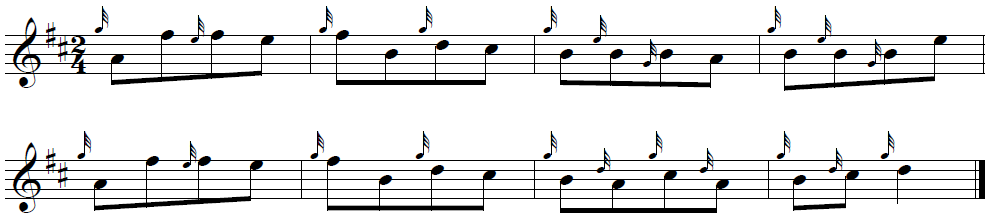
Drummond *- Slow Air
You can hear this
being played by Lindsay Davidson on the video below:
You
can also go to the special page for this tune where there are videos
of the tune being played by midi at different speeds and pitches.
You can hear this
being played by Lindsay Davidson on the video below:
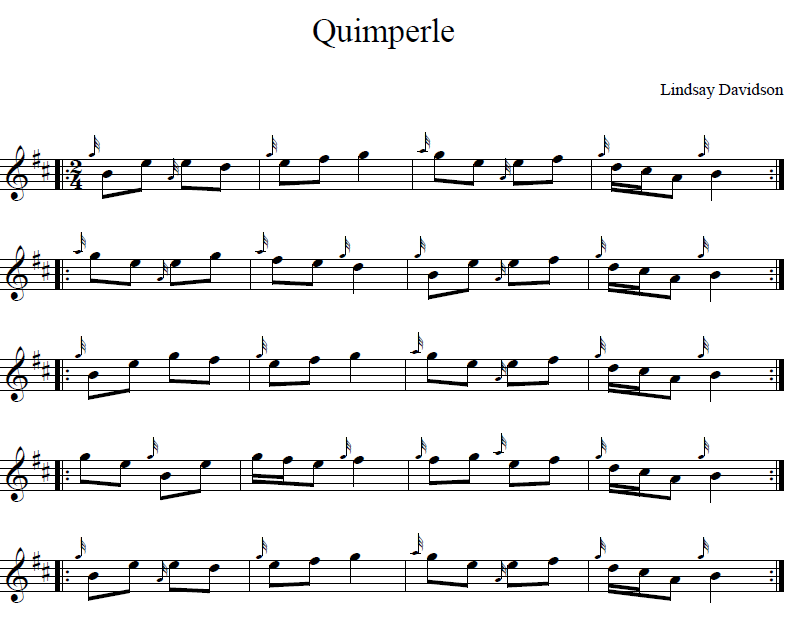
Quimperle* - Air
You can hear this being played by Lindsay Davidson on the video below:
If
you can play along with the video for each of the six exercises
above, and you have been playing these tunes with the videos, then
you are certainly ready to go to the next topic, throws.