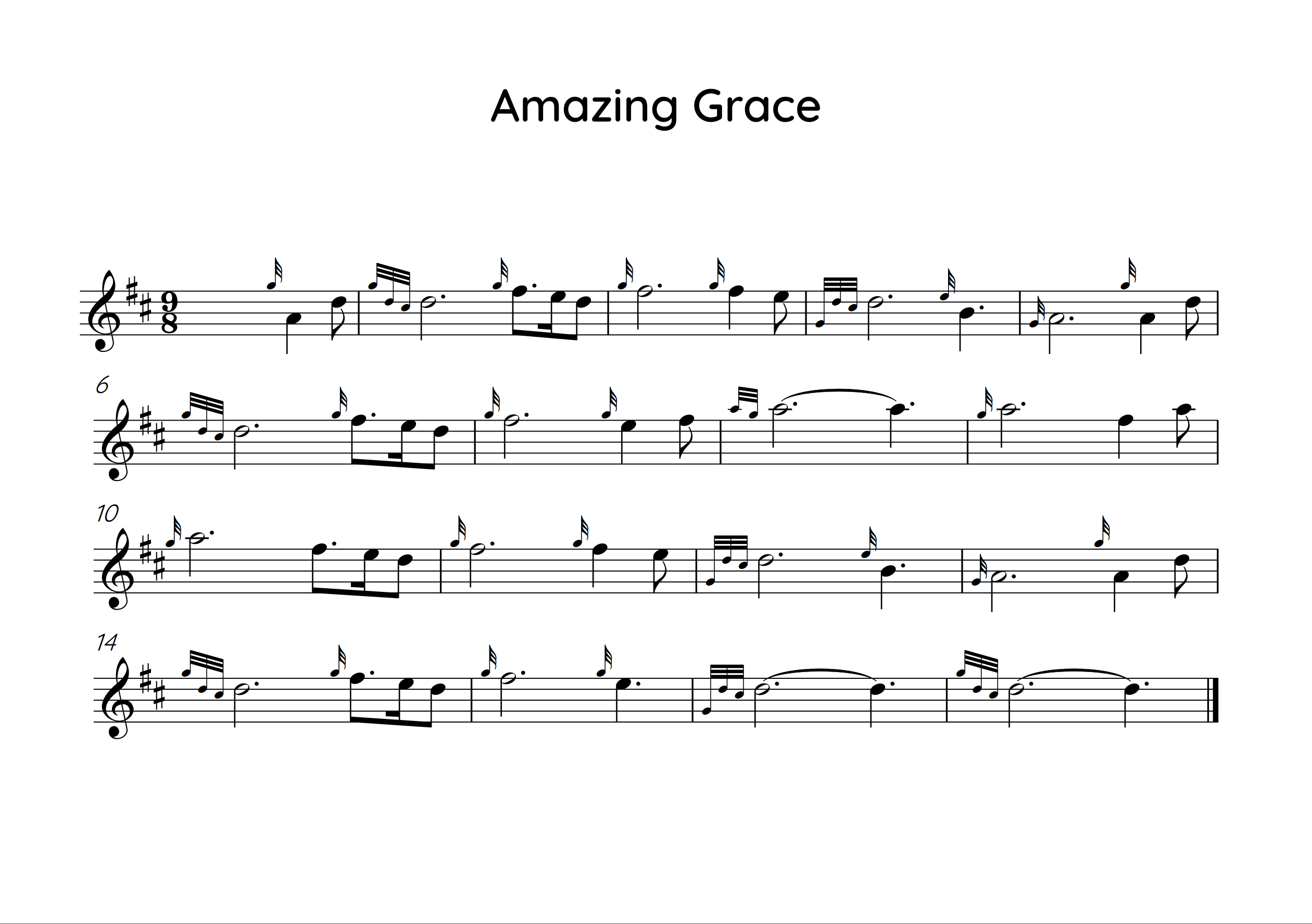
Perhaps
the most famous tune amongst the general public. This is, of course,
the pipe version of the hymn by John Newton, which he published in 1779.
This is often requested at funerals (and any time soeone sees a 'piper
too).
There are many versions, more or less complex in
terms of gracing.
Amazing Grace is always written in 3/4 time because this is how the
song is written, and sung. But when we play it instrumentally....it is
actually in 9/8.
Listen carefully and you will hear the truth.
It is notated here as it is actually played, so you may see it written differently if you ever see the music.
If you want the previous version of this page, it is here.
Learning tips
1 The high G gracenotes are all notated as 64th notes.
2 The hara, in ever case, happened entirely before
the beat and the strike opens up on the beat. The rhythm for his is
quite tricky, as the 8th note D is broken into a triplet and from
there, two-thirds are given before the D with the strike (but you have
to get the high G gracenote to close on that last third). The easiest
way to get on top of this is to listen very carefully. This is about
making the movement unharried and open and with a sense of time, space
and a kind of softness. And, alas, this is the kind of feeling you
often need in slow tunes. An exercise has been created to help deal
with the three common types of rhythmical shape of the 'hara' movement
(exercise 90)
3 The low Gs in the throws a re very long here.
Again, this is about giving te sense of crafting a beautiful sound. The
low G comes before the beat and opens on the beat. The strike is short
and light, giving the D the effect of being a 32nd note.
4 The high A doubling has the same basic idea as the
Ds in the throw - the A is repeated at a distance of a 32nd note from
it first sounding.
5 The strike on the high A is quite short, though it
should be felt by your thumb, otherwise it would be too short.
Videos to play along with (exercises below)
Low pitch normal speed
Low pitch half speed
Low pitch quarter speed
High pitch normal speed
High pitch half speed
High pitch quarter speed
To get more information and videos to play along with please follow the links for these exercises.